Inside Quis · Research guide
How to choose a survey question type that fits your research
Start with the answer you need. A practical guide to choosing between selection questions, ratings, open text, grids and prioritisation tasks.
By Quis · 4 min read · Published
A question type is a decision about the kind of evidence you want to collect. Before opening a questionnaire builder, write down what the next decision depends on: one choice, several experiences, a measurement, an explanation or a trade-off. That gives you a reason to choose a format.
This guide expands the first Inside Quis question-types post into a practical starting point for questionnaire design. The examples below are illustrative, not findings from a study.
Begin with the research decision
Imagine a team reviewing its customer-support service. It needs to know which channel customers used, how they felt about that experience and what should improve next. Those are different questions. Asking all three in one rating would produce an answer that is difficult to interpret.
Separate the decisions first. A selection question can identify the channel. A clearly labelled rating can measure an evaluation. An optional text question can ask what happened. The formats work together because each has a specific job.
Match the answer to the format
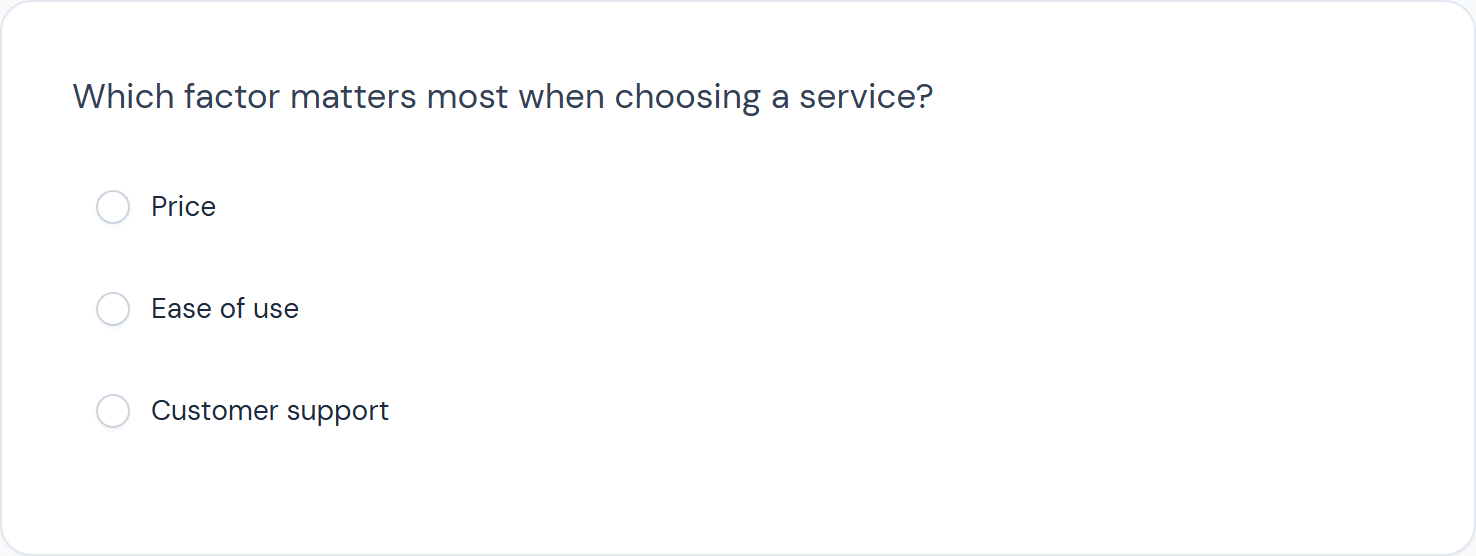
- One answer: Single Select or a single-choice Dropdown can record a main channel, an experience category or one preferred option. Make the question explicit about choosing one.
- Several answers: Multiple Select can record all relevant experiences, such as channels used within a defined period. Explain whether respondents should select all that apply or a limited number.
- A quantity: A numeric question can collect a count or amount. State the unit and time period rather than leaving people to infer them.
- An evaluation: A rating needs meaningful labels and a defined object. Satisfaction with the latest interaction is a different measure from satisfaction with the company overall.
- An explanation: Open text can capture an account in the respondent’s own words. Plan how you will review and organise those answers before collecting them.
Quis provides selection, grid, rating, numeric and open-ended formats, alongside other question types. The useful choice is the format that serves the study, rather than the largest number of formats in one questionnaire.

Use a grid only when the rows belong together
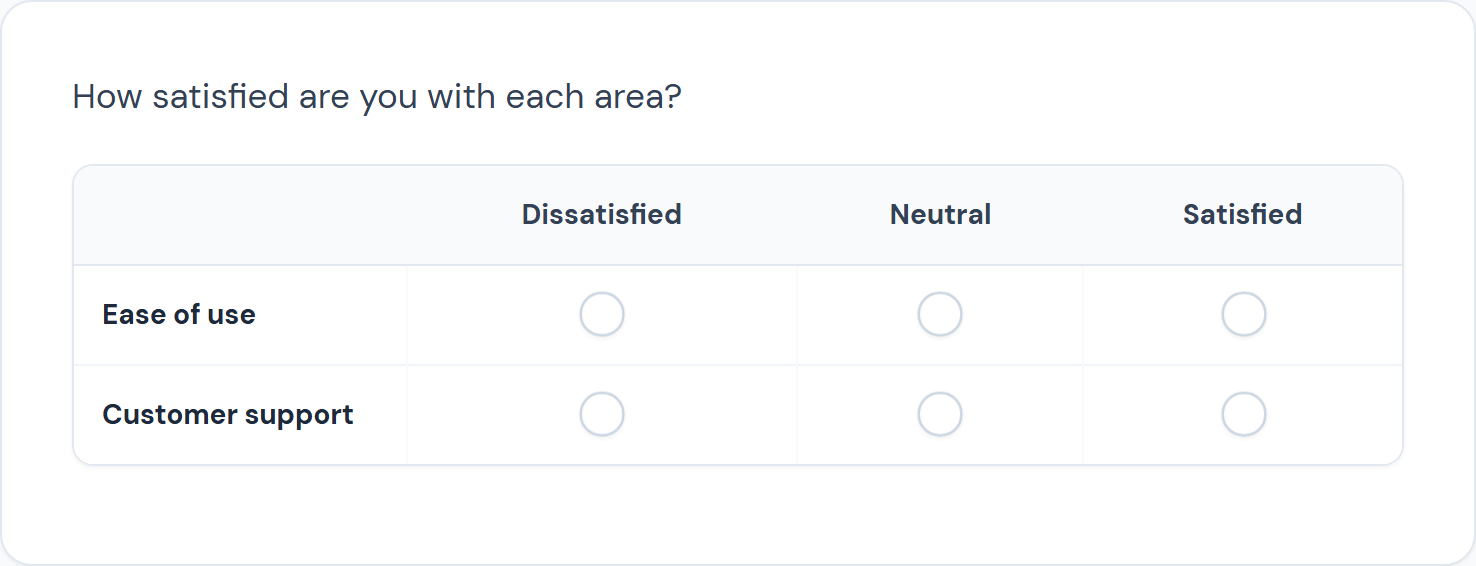
A grid can present several items against shared response options. For example, ease of use and customer support might each use the same evaluation scale. The items still need to be understandable on their own.
Look at the actual respondent view on a phone. Check whether the labels remain visible and whether people can follow the relationship between rows and columns. A compact builder layout is not enough to establish that a grid is easy to answer.
Distinguish a rating from a priority
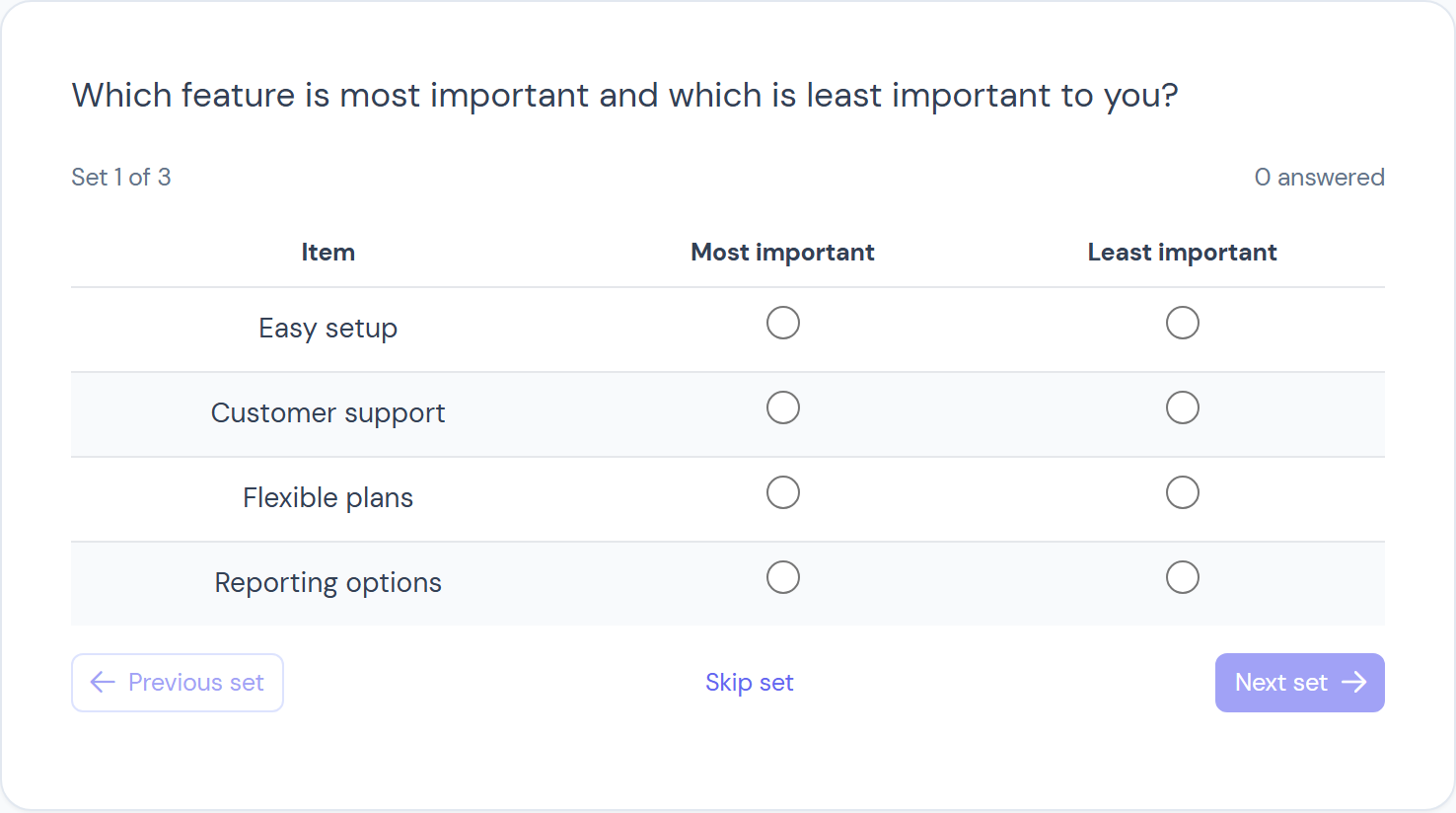
If the team needs to choose its next improvement, giving every feature a high importance rating may leave that decision unresolved. A main-priority choice, a ranking task or a more structured prioritisation method may address a different research need.
Quis includes Ranking and MaxDiff as distinct formats. They should not be treated as interchangeable with a satisfaction scale. Define the decision, task and analysis plan before choosing a prioritisation method; this introductory guide does not prescribe a MaxDiff design.
Check wording and response options together
A suitable format cannot repair an ambiguous question. Define the reference period, use familiar wording and avoid asking for two evaluations at once. Review whether options overlap or leave a likely answer unrepresented.
Pew Research Center discusses how question wording, answer categories and ordering can affect responses. AAPOR’s best-practice guidance also emphasises questionnaire development and pretesting. The Government Analysis Function’s design guidance puts respondent needs and testing within the wider design process. These principles support reviewing the whole task, rather than choosing a question type in isolation.
A short review before you build
- What decision will this answer inform?
- Should the respondent give one answer, several, a number or an explanation?
- Are the reference period, unit and response instructions clear?
- How will the answer be analysed alongside the rest of the study?
- Have potential respondents tried the question on the devices they will use?
Write those answers down, then build a short test questionnaire. In Quis, start with the question formats you need and preview the respondent experience before preparing the full study. Explore Quis Research or book a walkthrough.